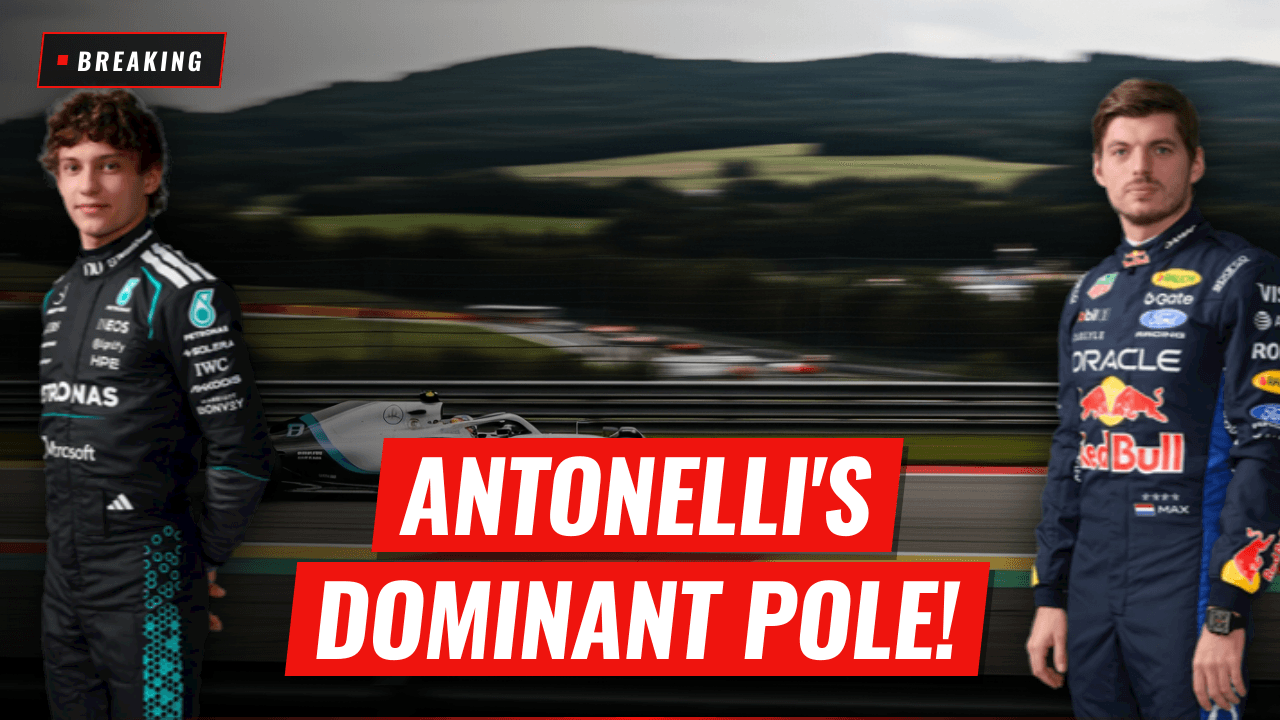
The 2026 Formula 1 season heads to Austin, Texas for Round 18, and our predictive models point to a defining weekend in the world championship fight. After back-to-back victories for Max Verstappen in Malaysia and Singapore disrupted Mercedes' mid-season dominance, the numbers project a firm counter-strike at the Circuit of the Americas.
Our data-driven forecast tips championship leader Andrea Kimi Antonelli to claim pole position and convert it into his ninth Grand Prix victory of the campaign. Behind him, the model projects a fiercely contested podium, with Verstappen edging out Lewis Hamilton for second, leaving Charles Leclerc and Lando Norris battling for the remaining top-five positions.
The Data Behind the Call
While Verstappen arrives in the United States as the form driver after sweeping Marina Bay from pole, COTA presents a radically different aerodynamic examination. Marina Bay’s traction-dependent stop-start layout rewarded the mechanical grip and low-speed balance Red Bull unlocked with their Baku upgrade package. Austin, by contrast, swings the pendulum back toward total aerodynamic efficiency.
Antonelli enters the weekend as the championship benchmark with 340 points. His season form index shows a peerless weighted average finish of P3.2 across 23 competitive sessions, yielding 15.4 points per event. Even during a difficult Singapore weekend where Mercedes struggled for qualifying trim, Antonelli climbed onto the podium on Sunday while averaging a season-long net grid-to-finish gain of +0.7 positions.
Our predictive model has also applied essential bias calibrations for Austin. Historical projections this season over-indexed Ferrari's Charles Leclerc by an average of 8.5 positions. After correcting for this skew, Hamilton emerges as the stronger Ferrari contender at COTA. Hamilton’s race-day execution—highlighted by his charge to second in the Singapore Sprint—and his proven adaptability around Austin's varied sectors make him our projected P3 finisher over his teammate.
What Circuit of the Americas Demands
The 5.513-kilometre Circuit of the Americas is one of the most uncompromising tests of modern machinery on the calendar, rewarding cars with broad aerodynamic envelopes:
- High-Speed Directional Changes (Sector 1): The downhill sweep through the Esses (Turns 2 through 6) punishes any instability in high-speed trim. Mercedes has maintained the field's highest mid-corner minimum speeds in medium- and high-speed sections all year.
- Traction and Braking (Sectors 2 and 3): The 1.2-kilometre back straight into the heavy braking zone of Turn 12 provides the primary overtaking opportunity, while the multi-apex stadium complex requires impeccable rear-tyre management.
- Tyre Degradation: Austin’s aggressive asphalt surface and lateral loads generate severe thermal degradation. Pit-stop loss time under green-flag conditions sits at roughly 20 seconds, placing strategic emphasis on managing the transition between the medium and hard compounds across a likely two-stop race.
Mercedes' chassis holds a significant projected delta over Red Bull through Sector 1, giving Antonelli the edge over single-lap qualifying simulations. While Red Bull’s straight-line speed will keep Verstappen lethal along the back straight, Antonelli’s high-speed sector advantage is expected to provide enough margin to control track position.
Drivers to Watch in Austin
Beyond the headline duel at the front, several key drivers enter the United States Grand Prix with notable statistical trends:
- George Russell: Following a dismal Singapore outing where an early sprint retirement left him qualifying deep in the pack, Russell recovered to ninth on race day. Sitting second in the standings on 238 points, our model expects a sharp qualifying rebound into the top four.
- Liam Lawson: The RB F1 Team driver has been the midfield standout of the autumn swing, posting a weighted average finish of P9.1 (second only to Antonelli on our form index). Lawson capitalized on wet conditions in Singapore to finish fifth in the Sprint and seventh in the Grand Prix, cementing his status as a regular Q3 contender.
- Arvid Lindblad: Our models previously under-rated the rookie by 1.6 positions per event. With that correction factored in, Lindblad’s recent qualifying pace—reaching Q3 in Singapore—positions him to battle Nico Hulkenberg's Audi for the final points places.
What the Race Will Hinge On
Sunday’s result will likely be decided in two distinct phases: the run up the hill into Turn 1, and the timing of the first pit cycle.
COTA’s steep uphill gradient into the blind apex of Turn 1 is notorious for opening up aggressive launch angles. If Antonelli secures pole as forecast, holding off Verstappen into that sweeping left-hander will be crucial.
If Antonelli maintains the lead through the opening stint, Mercedes' superior downforce levels should allow him to manage his tyre life without over-stressing the fronts, neutralizing Red Bull’s straight-line counter-attacks and setting up his path to victory.
For session-by-session breakdowns, projected lap time deltas, and head-to-head simulations, explore our latest race predictions ahead of opening practice.