Why F1 Cars Get Faster As Races End: The Fuel Effect Explained.
8 nov. 2026 · 4 min de lecture · Par F1 Predictions
Discover why Formula 1 cars get faster as the race progresses and how fuel mass dictates strategy.
Article
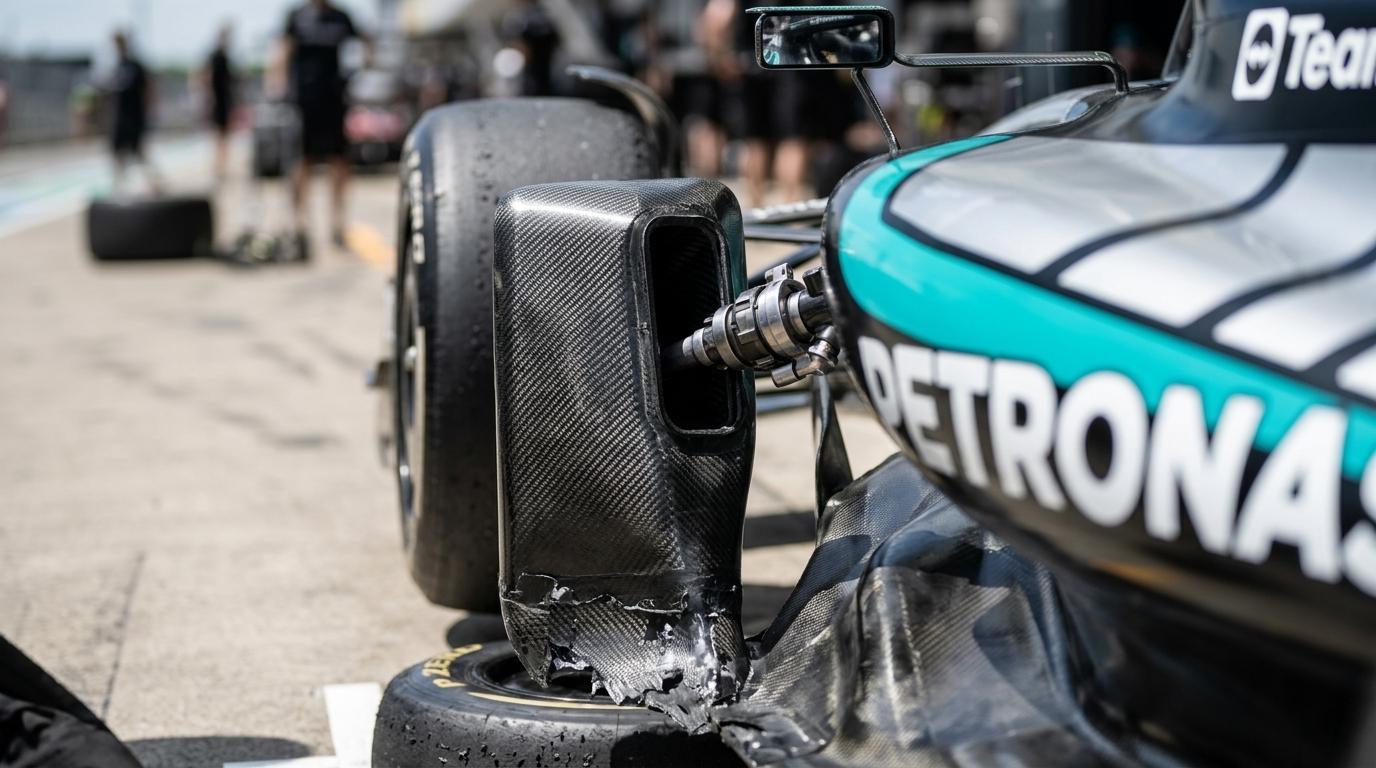
If you watch a Formula 1 race from start to finish, you will notice a bizarre paradox: as the laps tick down and tyres wear down to their canvas, the cars actually get faster.
Drivers frequently set the fastest laps of the entire Grand Prix in the final ten laps on well-used rubber. How can a machine perform better when its tyres are supposedly past their prime?
The answer lies in one of the most critical variables in modern motorsport data: the fuel effect.
What It Is
In Formula 1, in-race refuelling is strictly banned. When the cars line up on the grid on Sunday afternoon, every car must carry all the fuel it needs to reach the chequered flag inside its internal fuel cell.
Because of this rule, an F1 car starts the Grand Prix at its absolute heaviest and crosses the finish line at its absolute lightest. Over the course of approximately 300 kilometres (190 miles), cars burn through tens of kilograms of advanced sustainable fuel.
That steady loss of mass is what engineers call the "fuel effect." It is the continuous mechanical advantage a car gains simply by burning off the heavy liquid sitting behind the driver's seat.
Why It Matters
Raw lap times on Sunday are deceptive. If a car laps a circuit in 1m24.0s on Lap 5 and posts an identical 1m24.0s on Lap 35, an untrained eye might think the driver's pace has remained completely stagnant.
To a strategy engineer—or anyone building data-driven race models—that identical lap time tells a completely different story.
As a general rule of thumb across the Formula 1 calendar:
- Every 10 kilograms of fuel costs roughly 0.3 to 0.35 seconds per lap, depending on the length and layout of the circuit.
- Over a full race distance, shedding starting fuel weight makes a car naturally faster by 1.8 to 2.5 seconds per lap from lights-out to the finish.
Without adjusting for fuel burn-off, you cannot accurately assess tyre degradation or genuine car pace. When data analysts evaluate whether an upgrade package worked or which team possesses the superior race pace, their very first step is "fuel correction"—stripping away the invisible weight penalty to reveal the car's true speed.
How It Works
Mass is the natural enemy of racing performance. A heavier Formula 1 car suffers across three critical areas:
- Braking Distance: A heavier car carries significantly more kinetic energy at the end of a straight. The driver must brake earlier and apply more hydraulic pressure to stop, losing precious tenths on corner entry.
- Acceleration: Under Newton's second law, pushing more mass requires more force. A full fuel tank dulls the instant torque of the hybrid powertrain when accelerating out of slow-speed corners.
- Lateral Grip and Tyre Stress: Extra weight forces the tyres to work much harder to keep the car from sliding wide. That extra lateral load generates excessive friction, elevating surface temperatures and accelerating thermal tyre degradation.
Throughout a Grand Prix, two opposing forces constantly fight each other: tyre wear (which slows the car down) and fuel burn (which speeds the car up).
In the opening stint, fuel burns off rapidly, often masking early tyre wear and keeping lap times relatively flat. Eventually, the stint reaches a crossover point where tyre degradation degrades grip faster than fuel loss can compensate, forcing the driver into the pit lane for fresh rubber.
A Current-Season Example
The fuel effect explains how races unfold at the front of the grid in 2026.
Consider Andrea Kimi Antonelli's clinical performances for Mercedes this season. During long middle stints, Antonelli often locks into a metronomic rhythm where his lap times remain virtually flat over a span of 20 laps. Mathematically, his car is shedding roughly 0.05 to 0.07 seconds of weight penalty with each passing lap. Because his lap times are not falling, it proves his tyres are losing performance at the exact same rate the car is shedding mass.
Now look at what happens when a team decides to roll the dice late in a race. If Max Verstappen in the Red Bull or Lewis Hamilton in the Ferrari makes an aggressive second pit stop with ten laps remaining, they emerge on a brand-new set of soft tyres bolted onto an almost empty chassis.
Freed from 60-plus kilograms of race-start ballast, the car suddenly handles like a qualifying machine. The braking zones shorten, cornering speeds skyrocket, and the driver can routinely slash two seconds off their mid-race pace, sweeping past rivals burdened by older tyres to snatch fastest-lap bonus points.
Understanding the fuel effect turns a confusing timing screen into a clear strategic picture. The next time you see lap times tumble late in a Grand Prix, you will know exactly why the cars have suddenly come alive.
To see how our models account for fuel burn-off, tyre life, and race simulations, dive into our latest race predictions.
Lecteur
Votre prochain coup
Liés
Avant-course25 nov. 20264 MIN
Qatar GP Preview: Antonelli Tipped for Milestone Tenth Win
Analyse9 nov. 20264 MIN
Norris Dominates at Interlagos in Rain-Soaked Brazilian Grand Prix
Dossier1 nov. 20263 MIN
F1 Qualifying Explained: How the Knockout System Shapes the Sunday Grid
Actus30 oct. 20262 MIN
Audi Appoints Former Mercedes Powertrains Boss Thomas Fuhr as F1 Engine CEO
Dossier12 sept. 20263 MIN
Decoding F1 Grid Penalties: Why Drivers Start Out of Position
Actus30 juin 20263 MIN
FIA Confirms Major Technical Rule Changes for 2027 and 2028
Commentaires
- Aucun commentaire pour le moment. Soyez le premier.