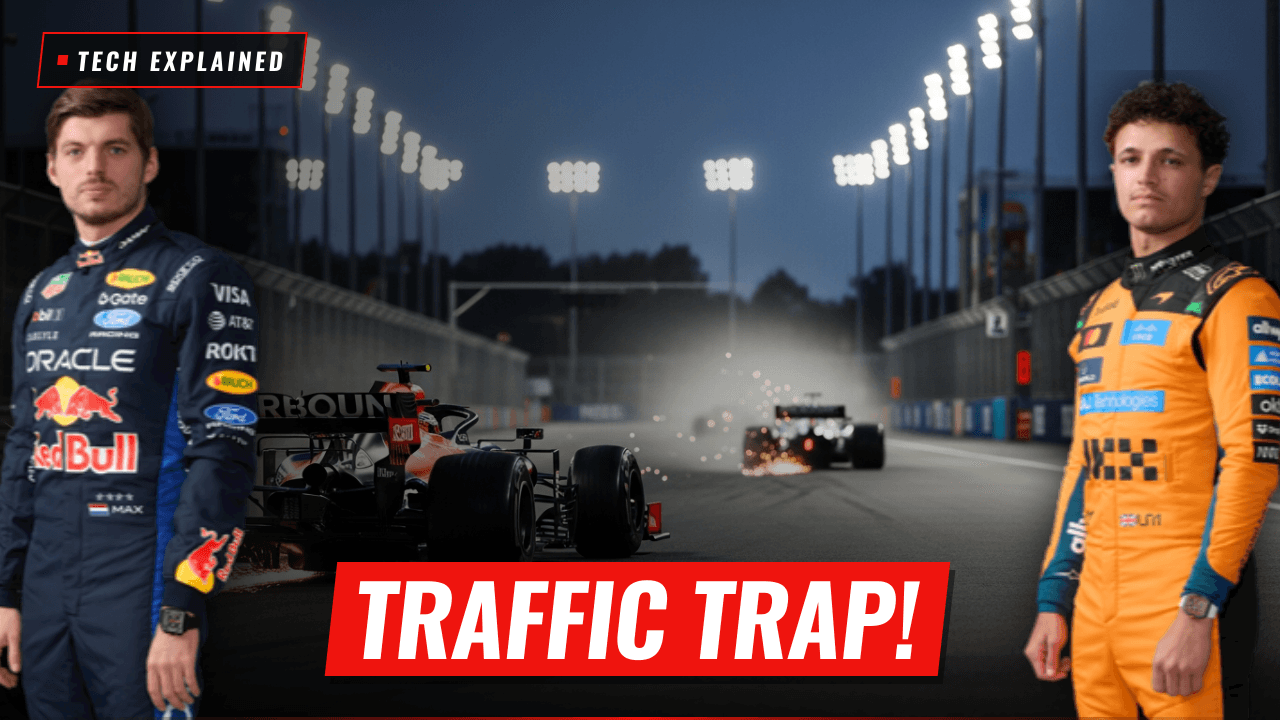
If you have been following the 2026 season closely, you have likely noticed a recurring moment of tension in the closing laps of a Grand Prix. The leader, perhaps Max VERSTAPPEN or Lando NORRIS, is comfortably out in front, only to suddenly encounter a thicket of cars that shouldn't be there. They are "backmarkers," and their presence changes everything.
For new fans, seeing the fastest driver in the world suddenly stuck behind a slower car can be baffling. Why is the leader struggling to pass, and why are the cars being passed seemingly getting in the way? This is the high-stakes world of lapped traffic, a dynamic that remains one of the most underrated strategic elements of Formula 1.
What is a Backmarker?
In Formula 1, a "backmarker" is a driver who has fallen behind the race leader by at least one full lap. Because the race is a set number of laps, if the leader is significantly faster than the rest of the field, they will eventually catch up to the cars at the back of the pack.
At this point, the leader is effectively racing cars that are physically ahead of them on the track but are technically a lap behind them in the classification. This creates a fascinating and often chaotic dynamic where the fastest car on the track finds itself nose-to-tail with a car that is, on average, a few seconds slower per lap.
The Blue Flag: Policing the Road
You might wonder why these slower cars don't just stay put. Formula 1 has a strict protocol for this: the Blue Flag.
When a faster car (the "lapping" car) approaches a slower car (the "lapped" car), race control alerts the slower driver via the marshal system. They are shown a physical blue flag, and their cockpit dashboard lights up with a blue warning.
Under the FIA sporting regulations, the lapped driver is required to allow the faster car to pass at the "earliest possible opportunity." They don't have to pull over and stop, but they cannot aggressively defend their position. If they ignore the blue flags for three consecutive marshalling sectors, they face a time penalty.
The Strategic Cost of Traffic
While the rules keep things orderly, the strategy of passing backmarkers is anything but simple. Even with the blue flags, the leader is at a disadvantage for several reasons:
- Dirty Air: As we have explored in other deep dives, F1 cars are aerodynamic beasts. When a leader pulls up behind a backmarker, the turbulent air coming off the slower car disrupts the leader's aerodynamics. This can cause a loss of downforce, making the leader’s car slide, overheat its tires, or lose grip in corners.
- The Rhythm Break: A race is a rhythmic, high-precision dance. A leader relies on specific braking points and turn-in speeds. When they have to navigate around a backmarker, they are forced to take a sub-optimal line, break their rhythm, and often lose precious seconds.
- Defensive Leverage: Sometimes, a canny driver will use backmarkers to their advantage. If a trailing car is trying to overtake the leader, the leader might "time" their pass of a backmarker perfectly—getting past just before a tight corner, effectively putting the backmarker between themselves and their rival, forcing the rival to slow down and wait.
A 2026 Season Example
We have seen this play out frequently throughout the 2026 season. Consider a scenario on a tight, technical circuit where overtaking is naturally difficult. Imagine a driver like Charles LECLERC pushing hard to maintain a gap to the car behind.
As they enter a technical sector, they suddenly catch a group of cars—perhaps battling for a position further down the order. Even if those drivers are technically "lapped," they might be in a heated wheel-to-wheel fight of their own. The leader now has to carefully pick their way through that battle without getting caught in the middle of a collision.
The pressure is immense: one hesitant move by the leader, or one missed blue flag by a backmarker, can cost the leader two or three seconds in a single lap. In a season as competitive as 2026, where every tenth of a second matters for the Constructor’s Championship, the ability to "clear traffic" is a skill that separates the championship contenders from the rest of the grid.
Understanding this dynamic transforms the race. It turns that moment when the leader gets stuck behind a car into a high-stakes puzzle, rather than just a moment of bad luck.
Want to see how our analysts predict the top drivers will navigate these challenges in the next Grand Prix? Check out our latest race predictions.