When you watch a Formula 1 weekend unfold, you will notice a stark shift on the timing screens. Lap times set during Friday's opening practice session are often two, three, or even four seconds slower than those set during Saturday afternoon's Qualifying session—even when ambient temperatures and weather conditions look virtually identical.
While drivers naturally push harder and engineers continuously refine mechanical setups as the weekend progresses, the primary driver behind this sudden burst of speed is an invisible physical phenomenon: track evolution.
Understanding how track evolution works is essential for anyone trying to interpret practice times, anticipate qualifying drama, or predict race strategy.
What It Is
Track evolution refers to the progressive increase in grip and the corresponding decrease in lap times as a racing surface transitions from a "green" state to a fully rubbered-in circuit over the course of an event.
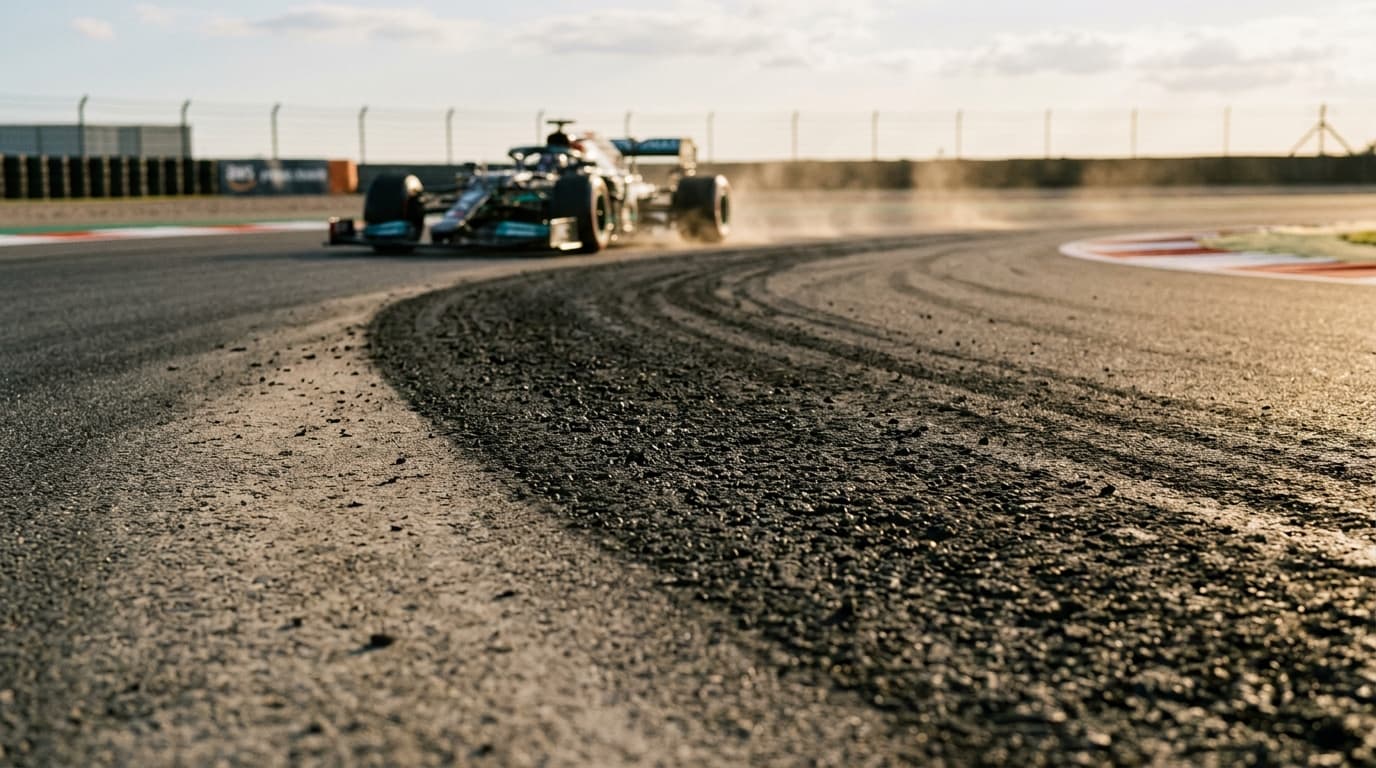
A racing circuit is not a static surface. As dozens of sessions take place across a Grand Prix weekend—including support categories and three Formula 1 practice sessions—the track physically changes. Microscopic layers of tyre rubber bond to the asphalt along the racing line, transforming the road from a slick, dusty ribbon of bitumen into an ultra-grippy surface capable of sustaining extreme lateral and braking forces.
Why It Matters
Track evolution is one of the most critical variables in race engineering and strategy. It shapes decisions across the entire weekend:
- Qualifying Timing: In knockout qualifying, circuit grip often peaks in the final seconds of Q3. Leaving the garage as late as possible ensures a driver runs on the grippiest possible surface, which can easily yield two or three tenths of a second compared to running early in the session.
- Tyre Life and Degradation: On a "green" track, low surface grip causes tyres to slide across the asphalt, creating high friction that tears the surface of the tread—a problem known as graining. As the circuit rubbers in, cars slip less, tyre wear stabilizes, and tyre longevity improves dramatically.
- Setup Decisions: Cars that suffer from excessive balance shifts during Friday practice may suddenly feel balanced on Saturday simply because the rear axle gains more natural traction from the rubbered-in asphalt.
- Data Modeling: Race strategists cannot simply look at raw lap times; they must strip out the estimated effect of track evolution to understand a car's true underlying pace.
How It Works
Track evolution is driven by friction, heat, downforce, and mechanical cleaning. The process follows a predictable lifecycle:
1. The "Green" Track
At the start of a Grand Prix weekend, particularly on temporary street circuits or venues that rarely host motorsport events, the asphalt is described as "green." It is coated in fine dust, environmental oils, and atmospheric grime. Because the cars slide around on top of this film rather than biting into the road, lap times are slow, braking zones are long, and drivers frequently lock their wheels.
2. The Sweeping Effect
As cars lap the circuit, their tyres and powerful underfloor aerodynamics act like giant vacuum cleaners. The turbulent wake and high-speed passage of the floor sweep away loose debris and dust, exposing the bare macro-texture of the asphalt.
3. Rubbering In
Formula 1 tyres operate at surface temperatures well above 100°C. Under hundreds of kilograms of vertical aerodynamic load in high-speed corners, the hot, sticky tread compound physically shears at a microscopic level.
Tiny particles of rubber are forced down into the pores and crevices of the stone aggregate. Because rubber generates far more friction when adhering to rubber than to bare rock, each passing car lays down an increasingly adhesive layer along the racing line.
4. The Rain Reset
The evolution process is fragile. A single sudden rain shower can wash away the loose rubber and leach natural oils back to the surface. When rain hits between Saturday Qualifying and Sunday's Grand Prix, teams find themselves starting the race on a "green" track all over again, throwing pre-race tyre models into turmoil.
A Current-Season Example
The impact of track evolution has been on full display throughout the 2026 season, where tight qualifying margins have repeatedly rewarded teams with flawless session execution.
With Mercedes setting the pace this year behind Andrea Kimi Antonelli and George Russell, the battle for pole position against Ferrari and McLaren has routinely come down to the final seconds of Q3. Because track evolution ramps up with every car that crosses the start-finish line, timing the final qualifying lap to be the last car across the stripe can represent the difference between pole position and third on the grid.
On street circuits like Melbourne, Baku, and Singapore, the evolution curve is especially severe. In early practice, drivers like Lewis Hamilton, Charles Leclerc, and Lando Norris often report low grip and rear sliding. Yet by Sunday afternoon, the racing line has evolved into a dark, high-grip corridor. Drivers who fail to adjust their braking points deeper into the corners as the grip builds leave crucial lap time on the table.
To see how circuit grip and weekend conditions shape our statistical models for the upcoming Grand Prix, explore our latest race predictions.