What is Parc Fermé in F1? Explaining the Sport's Rules.
24 ott 2026 · 4 min di lettura · Di F1 Predictions
Learn how the strict 'closed park' regulations shape engineering and strategy during an F1 race weekend.
Articolo
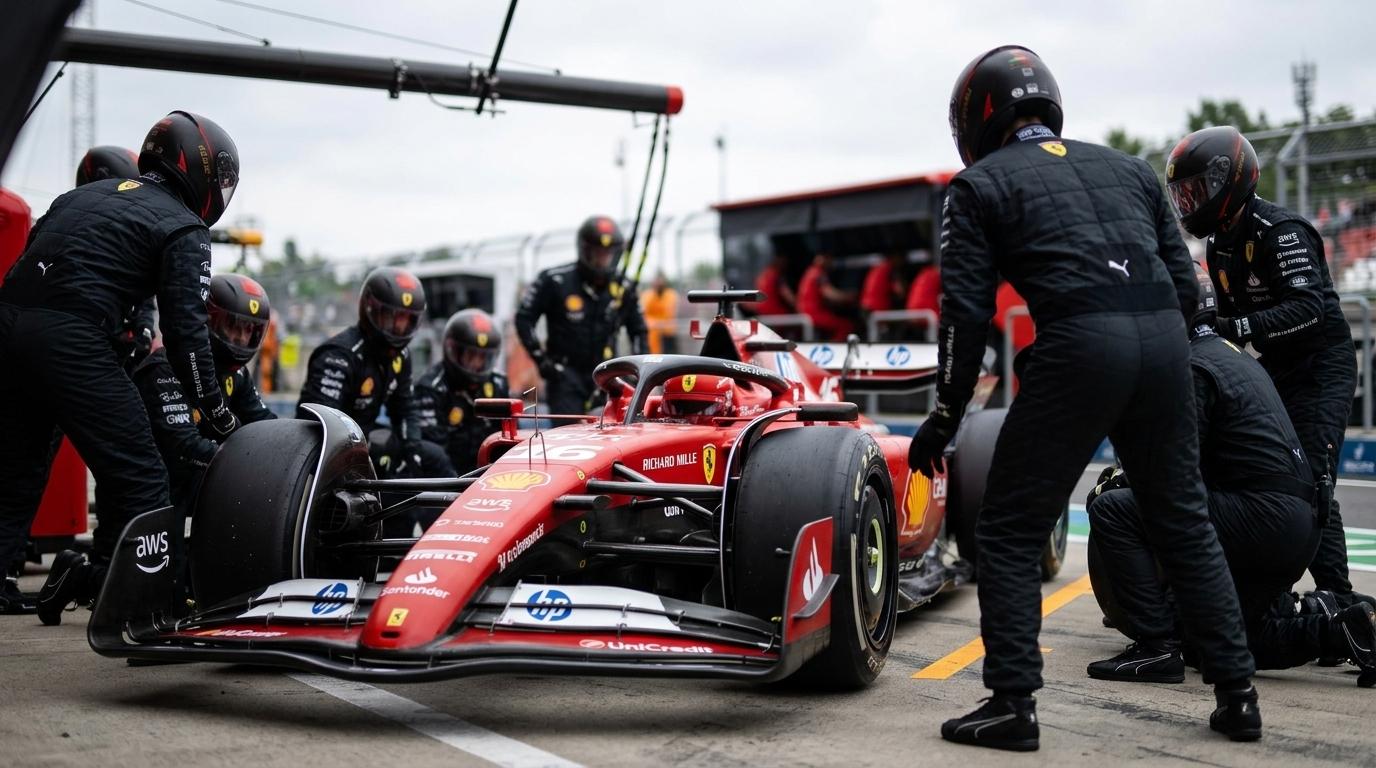
If you have ever watched a Formula 1 weekend, you might have noticed an abrupt shift after Saturday's qualifying session: mechanics stop tinkering with wing angles, the car disappears under protective covers, and commentators warn that making major adjustments will trigger a severe penalty.
That lockdown is governed by one of the most consequential rulebooks in motorsport: Parc Fermé.
What It Is
Parc Fermé is a French phrase translating literally to "closed park." Historically, it referred to a designated physical enclosure where race cars were driven immediately after a session to ensure they complied with technical regulations and could not be tampered with.
In modern Formula 1, Parc Fermé is less a physical paddock compound and more a legal status. Once a car leaves the pit lane during qualifying, it enters Parc Fermé conditions. Under these strict rules, the car is effectively frozen in its mechanical and aerodynamic specification until the start of Sunday's Grand Prix.
Why It Matters
Parc Fermé exists for three vital reasons: fairness, cost control, and engineering compromise.
- Preventing "Qualifying Specials": Without Parc Fermé, wealthier teams would build disposable cars tailored strictly for a single flying lap on Saturday. They could run razor-thin ride heights, extreme suspension stiffness, and ultra-fragile lightweight components to capture pole position, then spend Saturday night replacing everything with durable, compliant parts for the Grand Prix.
- Cost and Personnel Limits: Rebuilding two cars from the ground up between Saturday evening and Sunday morning would require around-the-clock shifts from dozens of mechanics. Parc Fermé caps that operational arms race, protecting mechanic well-being and keeping team operational budgets in check.
- The Engineering Compromise: Because the car that qualifies is the car that races, engineers cannot optimize solely for ultimate single-lap pace or purely for 300-kilometer tyre preservation. They must find a delicate balance that delivers enough speed over one lap without punishing tyres or destroying balance over a full race stint.
How It Works
Once a car rolls out of the garage in Q1, the lockdown begins. FIA technical delegates place seals on key components, and onboard cameras monitor garages overnight to ensure teams adhere strictly to the list of permitted actions.
Under Parc Fermé conditions, mechanics are strictly limited in what they can touch.
Permitted tasks include:
- Changing tyres and adjusting tyre starting pressures
- Adding or removing fuel
- Bleeding the braking system
- Minor front wing flap angle adjustments using existing adjusters
- Routine safety checks, spark plug inspections, and fluid top-ups
- Repairing crash damage, provided the replacement parts are identical in specification, mass, and design to the originals, with FIA approval
Forbidden tasks include:
- Altering suspension geometry, spring rates, or anti-roll bar settings
- Changing ride heights
- Swapping to a different aerodynamic specification (such as switching from a high-downforce rear wing to a skinny low-drag wing)
- Changing baseline engine mapping philosophies or gearbox gear ratios
If a team breaches these restrictions—either to repair severe damage with non-identical parts or to make a radical setup change after a dreadful qualifying session—the penalty is swift: the driver forfeits their grid slot and must start the race from the pit lane.
A Current-Season Example
The strategic jeopardy of Parc Fermé has been on full display throughout the 2026 championship. With Mercedes setting the benchmark at the top of the standings—where Kimi Antonelli and George Russell have combined for 11 victories—getting the mechanical platform dialed in during early practice is paramount.
When a team gets that baseline wrong, Parc Fermé traps them in a high-stakes dilemma. In the hyper-competitive chasing pack featuring Ferrari, McLaren, and Red Bull, even a tiny miscalculation in track temperature or tyre graining can leave a driver stranded with an ill-handling car on Saturday afternoon.
If a driver like Charles Leclerc, Lewis Hamilton, or Max Verstappen qualifies in seventh or eighth place with a setup that overheats the rear tyres, their engineering team faces an agonizing overnight choice:
- Accept the compromise: Keep the car locked in Parc Fermé, retain the starting position on the grid, and hope race craft and strategy can salvage a strong points finish.
- Break Parc Fermé: Pull the car out of the lockdown, re-engineer the ride height and wing levels to create a proper race car, and accept the mandatory pit-lane start.
Starting from the pit lane turns Sunday into an uphill recovery drive, but when a car's locked-in setup is fundamentally flawed, teams often judge that starting from the back with a fast car is better than starting mid-pack with an uncompetitive one.
Understanding Parc Fermé reveals the hidden chess match of Formula 1: a team's weekend isn't just decided by raw pace, but by whether their engineers solved the riddle of the circuit before the garage doors locked on Saturday afternoon. To see how these setup compromises shape our forecast for the next race, take a look at our latest race predictions.
Lettore
La tua prossima mossa
Correlati
Anteprima25 nov 20264 MIN
Qatar GP Preview: Antonelli Tipped for Milestone Tenth Win
Approfondimento1 nov 20263 MIN
F1 Qualifying Explained: How the Knockout System Shapes the Sunday Grid
Approfondimento12 set 20263 MIN
Decoding F1 Grid Penalties: Why Drivers Start Out of Position
Approfondimento14 ago 20264 MIN
The Traffic Game: How Lapped Cars Impact F1 Races
Approfondimento8 ago 20263 MIN
The Language of the Circuit: Understanding F1's Flag System
Approfondimento17 lug 20264 MIN
The Art of the Edge: Understanding F1 Track Limits
Commenti
- Ancora nessun commento. Sii il primo.