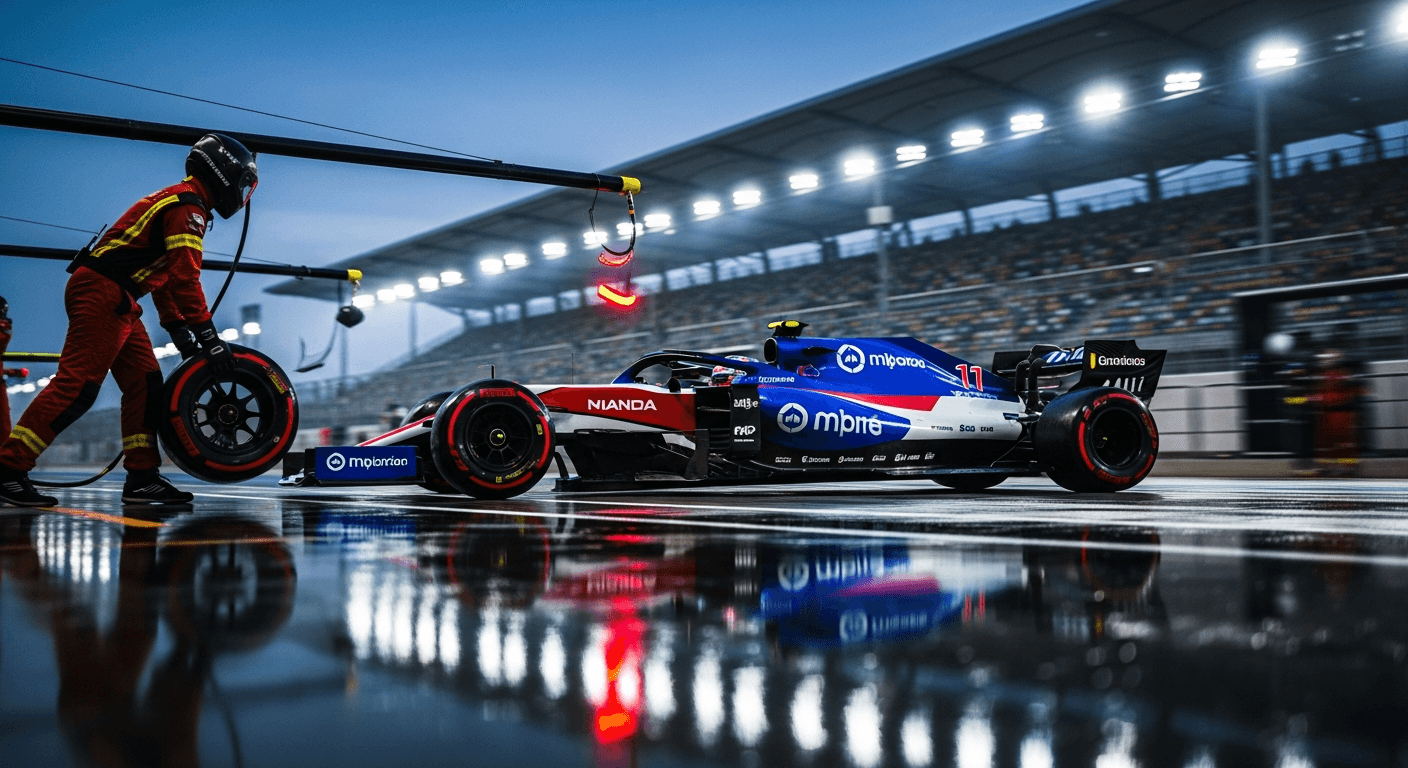
In Formula 1, speed is the obvious currency. If you have the fastest car and the best driver, you are going to win races. However, if you have ever tuned into a Grand Prix and felt confused why a driver pitted for new tires five laps before their rival—only to suddenly emerge ahead of them—you have witnessed one of the most elegant strategic battles in motorsport.
Welcome to the world of the Undercut and the Overcut. These aren't just technical terms; they are the chess moves of F1 strategy, and understanding them is the secret key to truly enjoying a race weekend.
What is the Undercut?
The undercut is an aggressive strategy where a driver pits earlier than the car they are trying to overtake.
In a world where track position is king and overtaking on-track can be incredibly difficult due to the aerodynamic turbulence of the car in front (known as "dirty air"), teams often look for a way to leapfrog rivals in the pits.
If Max Verstappen at Red Bull is stuck behind Oscar Piastri at McLaren, he might choose to pit earlier than his team actually needs to. By putting on a fresh set of rubber, Verstappen can drive significantly faster on his "out-lap" (the first lap after a pit stop) than Piastri can on his older, worn-out tires. When Piastri eventually pits a few laps later, he comes out of the pit lane and discovers that Verstappen has already flown past him.
What is the Overcut?
The overcut is the tactical opposite. It is the strategy of staying out on the track longer than your rival.
This is often used when a driver has high confidence in their ability to manage tire life. While the rival pits early to go for the undercut, the driver staying out tries to pump in a few "clean air" laps—driving as fast as possible without another car blocking them—hoping that their tires remain fast enough to maintain the gap.
The overcut is riskier, but it pays off if the rival hits traffic or struggles to get their new tires up to the correct operating temperature quickly.
Why Do These Strategies Matter?
The beauty of F1 strategy lies in the trade-off. If you pit too early for an undercut, you run the risk of having no grip left at the end of the race, leaving you vulnerable to being overtaken in the final laps. If you try for an overcut, you risk losing too much time on your aging tires before you finally pit.
Every team, from Ferrari to Williams, uses sophisticated simulation software to predict the "delta." The delta is the difference in lap time between a car on new tires versus a car on old tires. If the delta is large enough—for instance, if new tires are two seconds per lap faster—the undercut becomes extremely powerful. If the delta is small, the strategy has less impact.
A Current-Season Example
To see how this plays out in the 2026 season, imagine a scenario where Lewis Hamilton (Ferrari) and George Russell (Mercedes) are locked in a close battle for position at a high-degradation circuit.
Hamilton is sitting in P4, right behind Russell in P3. The Mercedes driver is struggling slightly with rear-tire wear. The Ferrari pit wall notices that Russell’s lap times are beginning to drop by a few tenths per lap.
Ferrari calls Hamilton into the pits first. He takes a fresh set of tires and drives an absolutely blinding out-lap, taking advantage of the extra grip. Because Russell stayed out, he had to navigate a lap on "old" rubber, which is slippery and slow.
By the time Mercedes calls Russell in for his own stop, the damage is done. Russell exits the pit lane and finds Hamilton has already swept past him. Hamilton successfully executed an undercut.
However, if Russell had possessed the tire management skills to keep his lap times consistent—and if he had a clear track ahead—he might have kept his lead, rendering Hamilton’s early stop ineffective.
The Data-Driven Edge
This is where the race is often won or lost, far away from the overtakes that make the highlight reels. It’s a constant tug-of-war between the drivers on the track and the engineers on the pit wall, balancing tire temperature, fuel loads, and the unpredictable nature of other cars on track.
If you enjoy breaking down these strategies and want to see which drivers are best at managing their races, check out our latest race projections. Our model tracks tire degradation and historical pit-lane performance to help you see who is likely to pull off the next great strategy masterclass.